Creative · Beginner
Paint fruit, flowers and animals in watercolor, one picture at a time
A practical online course that teaches all the main watercolor techniques through 20 finished paintings you will be proud to frame or give away.
- 20 finished paintings
- All core watercolor techniques
- Fruit, flowers and animals
- Self-paced video lessons
- 14-day refund policy
Why watercolor feels hard until someone shows you the order of steps
Watercolor looks effortless in the hands of an experienced painter: a few soft strokes and a rose appears on the page. When you try it yourself, the paint runs where you did not want it, the colors turn muddy, and the paper buckles. Many people decide that they simply have no talent and put the brushes away.
In reality, watercolor is a craft with clear rules. How wet the paper is, how much water is on the brush, when you add a second layer and when you wait: these decisions decide the result far more than any natural gift. Once you understand them, the medium becomes predictable and, above all, enjoyable.
This course is built around that idea. Instead of long theory lectures, you learn each technique while painting something real. Every picture introduces one or two new skills, and every skill is used again in the next pictures, so nothing stays abstract.
By the end you will have painted 20 complete works. You will have a small collection of your own paintings, and, more importantly, the confidence to start a new picture without a tutorial open next to you.
What you will be able to do
- Paint fruit with believable volume
Use light, shadow and soft transitions to make an apple or a pear look round on flat paper.
- Paint flowers with delicate petals
Build up translucent layers so roses and other blooms look fresh rather than heavy.
- Draw animals in a loose, lively style
Capture fur, posture and expression with simple shapes and confident brushwork.
- Control water on the brush and the paper
Judge moisture so that paint spreads exactly as far as you intend.
- Mix clean, harmonious colors
Combine a small set of paints into a wide range of shades without turning them to mud.
- Use the main watercolor techniques
Apply washes, wet-on-wet, wet-on-dry, glazing and detail work in the right situations.
- Plan a painting before you start
Decide where to keep white paper, which layer comes first and where details belong.
- Finish a picture calmly
Know when to stop, how to fix small slips and how to present the final work.
- 20
- watercolor paintings completed
- 5
- modules
- 3
- subjects: fruit, flowers, animals
- All
- main watercolor techniques covered
Learn by painting, not by listening
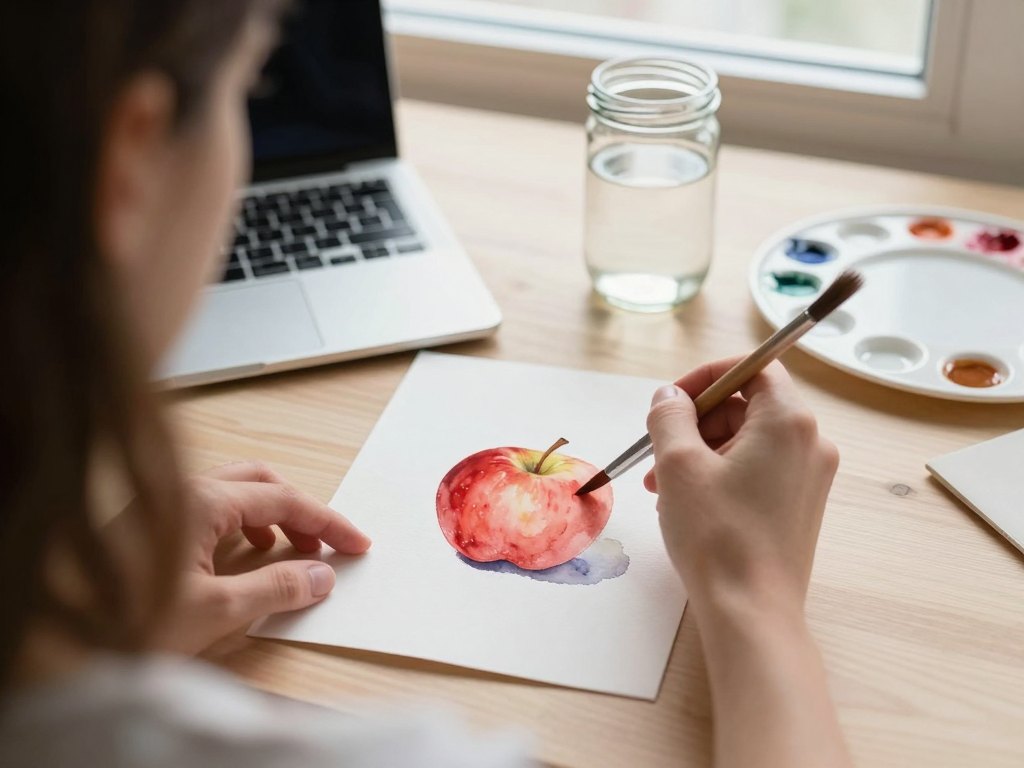
Each lesson is a complete painting. You watch the picture being built from the first pencil sketch to the last highlight, and you paint along at your own speed, pausing as often as you need.
Because the subjects repeat in different forms, you see how the same technique behaves on a peach, on a petal and on a cat's fur. That repetition is what turns a trick you copied into a skill you own.
- One finished picture in every lesson
- New techniques introduced inside real subjects
- Each skill revisited in later paintings
- Pause, rewind and paint at your own pace
How the course works
The course is an online programme delivered as video lessons. You can start as soon as your payment is confirmed and study whenever it suits you: an hour in the evening, a quiet weekend morning, or a single picture over several short sittings.
The modules move from simpler subjects to more demanding ones. You begin with basic shapes and washes, then move on to fruit, flowers and finally animals, where you combine everything you have learned. You can follow the order we suggest or return to any lesson whenever you want to repeat a technique.
You will need only standard watercolor supplies: paints, a few brushes, watercolor paper and a jar of water. The first lesson explains what to choose and what you can safely skip, so you do not have to spend money on equipment you will not use.
The programme
Five modules, twenty paintings. Every lesson ends with a finished picture.
1Module 1 — First steps with water and colorGet comfortable with your materials and the basic movements of the brush.4 paintings
- Setting up your materials and workspace
- A simple apple: your first flat wash
- Two-color pear with a soft transition
- Lemon slices with light and shadow
2Module 2 — Fruit with volumeTurn flat shapes into rounded, juicy-looking objects.4 paintings
- Peach with a blended blush
- Grapes using layered glazes
- Cherries with sharp highlights
- Still life of mixed fruit on a table
3Module 3 — Delicate flowersWork with thin, translucent layers and keep your colors clean.4 paintings
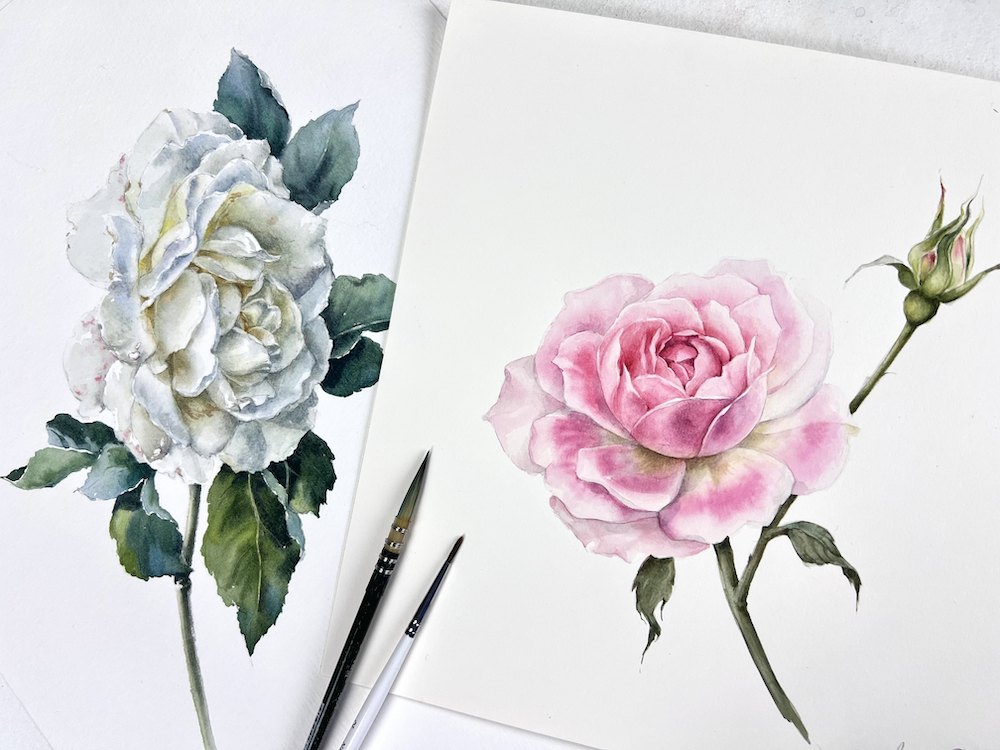
- A white rose on a soft background
- A pink rose with wet-on-wet petals
- A branch with small blossoms
- Wildflower bouquet in a loose style
4Module 4 — Leaves, stems and compositionsAdd greenery and learn to arrange several elements on one sheet.4 paintings
- Mixing natural greens for leaves
- Poppies with stems and buds
- A wreath of flowers and leaves
- A bouquet in a jar with reflections
5Module 5 — Animals in watercolorBring together every technique to paint living subjects.4 paintings
- Simple shapes for drawing animals
- A fluffy cat using layered strokes
- A bird with delicate feather detail
- A final picture of your own choice
What you get
- Video lessons you can watch at any time
Every painting is shown step by step from sketch to finishing touches.
- A clear path through all main techniques
Techniques are introduced in a sensible order and practiced several times.
- Materials guidance
Advice on paints, brushes and paper so you buy only what you need.
- 20 finished pictures
A personal collection of paintings made by your own hand.
- Lasting access to the lessons
Return to any lesson to repeat a technique or paint a favorite subject again.
- A relaxing creative habit
Regular painting sessions that give you time away from screens and worries.
Is this course for you?
This course is for you if…
- You have never painted with watercolors and want a gentle, structured start
- You tried watercolor before and were frustrated by muddy colors or uncontrolled water
- You enjoy painting as a hobby and want to finish pictures you can display or give as gifts
- You like learning by doing and prefer step-by-step demonstrations to long explanations
- You want a calm creative pastime that fits around a busy schedule
Probably not a fit if…
- You are looking for personal feedback on each of your paintings from a teacher
- You want to study oil, acrylic or digital illustration rather than watercolor
- You expect to become a professional artist in a few weeks without regular practice
After the course
When you finish the final lesson, you will have a stack of 20 paintings on your desk: fruit that looks good enough to eat, flowers with soft petals, and a few animals with real character. Looking at the first and the last picture side by side, the progress is usually striking.
You will understand how water, pigment and paper work together, and you will be able to choose a technique for a new subject instead of guessing. Mixing colors, planning white space and layering washes will feel natural rather than risky.
From there you can paint from photos, from life or from your imagination. Many learners go on to make cards, gifts and small home decorations, or simply keep a sketchbook that grows a little each week.
Questions before you order
How much time do I need each week?
There is no fixed schedule. One painting usually takes a single sitting or two short ones, so an hour or two a week is enough to make steady progress. If you can paint more often, you will simply move through the programme faster.
Do I need any drawing or painting experience?
No. The course starts with the most basic movements and builds up gradually. If you can hold a brush, you can begin.
What materials do I need?
Watercolor paints, a few brushes, watercolor paper, a jar for water and a palette. The first lesson explains what to look for, so you can start with an affordable set.
How does access work after payment?
Once your payment is confirmed you receive access to the lessons through your account. You can start immediately and study at your own pace on a computer, tablet or phone.
What format are the lessons in?
The lessons are recorded video demonstrations. You watch each painting being created step by step and paint along, pausing and replaying whenever you need.
Will the material stay available after I finish?
Yes. The lessons remain in your account, so you can repeat any painting or technique whenever you like.
What if the course is not right for me?
You can request a full refund within 14 days of purchase. If the course does not suit you, simply contact our support team within that period.
Can I paint along if I am left-handed or have only a few free minutes at a time?
Yes. Lessons are self-paced and can be paused at any point, so you can split a painting into short sessions. Left-handed painters simply mirror the demonstrations.
Start your first watercolor this week
Twenty paintings are waiting to be painted. Order the course today and begin with a simple apple.