Fitness · Beginner
Build a calm, mobile body with a simple qigong routine
Four modules take you from first warm-up exercises to a complete 25-exercise dynamic complex that you can practise on your own at home.
- 4 step-by-step modules
- Self-paced video lessons
- 25-exercise dynamic complex
- Suitable for complete beginners
- 14-day money-back guarantee
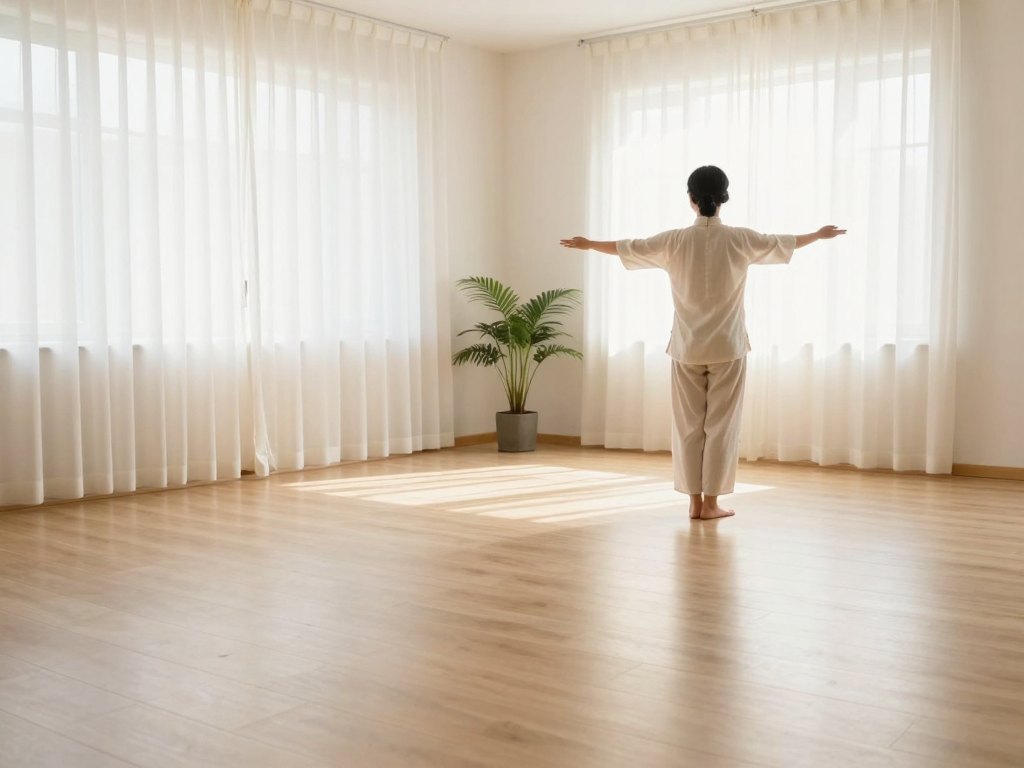
Why a gentle practice is easier to keep than a workout
Many adults spend the day at a desk or in a car and notice the results in the evening: stiff wrists, a tight neck, heavy legs and a mind that will not switch off. Intense gym programmes are not always the answer. They demand time, energy and a level of fitness that you may not have after a long day.
Qigong takes a different approach. It is a traditional Chinese practice built from slow, repeated movements, self-massage, standing postures and deliberate attention. You do not need special equipment, a large space or any sporting background. What you need is a clear order of learning and a demonstration of exactly how each movement looks.
This programme gives you that order. It starts with the parts of the body that suffer most from modern routines, the hands, feet, neck and head, and then moves on to standing practice, attention training and a full dynamic complex. Each step prepares you for the next, so you are never asked to do something you have not been shown.
The course is a general wellbeing and physical development programme. It is not a treatment for any illness and does not replace advice from a doctor. It is a way to move, relax and concentrate with more awareness.
What you will be able to do
- Warm up your hands, feet and neck
Use short self-massage and mobility exercises to loosen the areas that tighten most during a working day.
- Stand in the Big Tree posture
Hold a static standing exercise with a relaxed, well-aligned body.
- Direct your attention on purpose
Practise moving and holding your focus instead of letting it drift.
- Locate the three attention centres
Understand the Dan Tian concept and work with it in simple exercises.
- Combine posture with shifting attention
Perform the standing Tree exercise while switching your focus between centres.
- Prepare the body for a longer complex
Use a dedicated warm-up before you start the dynamic exercises.
- Learn the Nei Yang Gong exercises one by one
Study the 25 exercises of the dynamic complex in a sensible order.
- Perform the whole complex from start to finish
Run through the full sequence at a steady pace as a regular home practice.
- Coordinate movement and awareness
Improve balance and coordination by linking each movement to your attention.
- 4
- modules
- 19
- video lessons
- 25
- exercises in the dynamic complex
- 3
- attention centres explained
Why the order of the lessons matters
Most people who try qigong from random videos give up because the movements look simple but feel confusing. They do not know which part of the body to relax first, where to place their attention, or how to connect separate exercises into a routine.
In this programme the learning path is deliberate. First you prepare the body with exercises for the hands, the feet and lower legs, and the neck and head. Then you learn a standing exercise that teaches you to stay still without tension. Only after that do you work on attention, and only after that do you learn the dynamic complex.
By the time you reach the full sequence, the individual movements are familiar and your body has already been warmed up in the same way many times. You are learning the complex rather than struggling with it.

How the course works
The course consists of self-paced video lessons grouped into four modules. You can follow them in order at whatever speed suits you: one lesson a day, a few a week, or a longer session at the weekend. Nothing is scheduled, so you decide when to practise.
Most lessons are practical. Each exercise is demonstrated, the position and the sequence of movements are explained, and then you repeat it with the recording. A few lessons are short talks that explain the basic concepts of the practice, so you know why you are doing what you do.
The programme includes checkpoints so you can see whether you are ready to move on. You can return to any lesson as often as you like and replay difficult movements at your own pace.
Wear comfortable clothing and choose a spot where you can stretch your arms to the sides. A chair, a mat and a quiet corner are enough.
The programme
Four modules, from preparing the body to performing the complete dynamic complex.
1Module 1 — Introduction to qigong and preparing the bodyBasic concepts, self-massage and first exercises for the areas that tighten most.6 lessons
- Introduction to the module
- Basic concepts of wellness practice (talk)
- Exercises for the hands: qigong for the wrists and fingers
- Exercises for the feet and lower legs: qigong for the legs
- Exercises for the neck and head: qigong for the neck and shoulder area
- Static exercise Big Tree (Zhan Zhuang) and module summary
2Module 2 — Attention and coordination (Dan Tian)Train deliberate attention and link it to a standing posture.5 lessons
- Introduction to attention training
- The three attention centres of the body (Dan Tian)
- Static exercise Tree with shifting attention (working with Dan Tian)
- Combining posture, breathing rhythm and attention
- Intermediate checkpoint
3Module 3 — The dynamic wellness complex (Nei Yang Gong)Learn the 25 exercises step by step and then practise the whole sequence.6 lessons
- Introduction to the dynamic complex
- Warm-up before the Nei Yang Gong complex
- Learning the exercises of the complex (1–25)
- Performing the complete Nei Yang Gong complex
- Common mistakes and how to correct them
- Final checkpoint for the complex
4Module 4 — Final reviewBring the three parts of the programme together.2 lessons
- Reviewing the whole programme: preparation, standing practice and the complex
- Building a regular home routine from what you have learned
What you get
- Four modules of video lessons
Structured so each step prepares you for the next.
- Demonstrations of every exercise
See the position and the movement before you try it.
- Self-massage and mobility routines
Short sequences for the hands, feet, neck and head.
- A standing practice you can repeat daily
The Big Tree exercise and its variation with shifting attention.
- The complete 25-exercise complex
Learn the movements individually and then as one flowing sequence.
- Checkpoints along the way
Review points that show whether you are ready for the next module.
- Access on any device
Watch on a phone, tablet or computer, wherever you practise.
- Lessons you can replay
Return to any video and keep it as a long-term reference.
Is this course for you?
This course is for you if…
- You are a complete beginner and want a clear starting point in qigong.
- You sit for most of the day and want short routines to loosen your body.
- You prefer gentle, low-impact practice to intense exercise.
- You want to train attention and calm as well as movement.
- You like learning at home and at your own pace.
Probably not a fit if…
- You are looking for a treatment for an illness or a medical condition.
- You want a high-intensity workout or rapid weight loss.
- You expect personal feedback or one-to-one correction from a teacher.
- You are not willing to practise regularly, even for a short time.
After the course
When you finish the programme, you have a practice that fits into an ordinary day. You can open with a few minutes of hand, foot and neck exercises, stand quietly in the Tree posture, or run through the complete complex when you have more time.
You will recognise where tension collects in your body and know which exercise addresses it. You will also have a basic understanding of the three attention centres and a feeling for how to hold your focus while your body moves.
Most importantly, you will have a structure you can keep using on your own. Qigong rewards small, regular sessions, and the lessons stay available so you can come back whenever you want to refresh a movement.
Questions before you buy
How much time do I need each week?
It is up to you. A single lesson usually fits into a short session, and many people practise a few times a week. The programme is self-paced, so you can go faster or slower depending on your schedule.
Do I need any previous experience?
No. The course starts with the basics and introduces every exercise step by step. No sporting background or knowledge of qigong is required.
Do I need special equipment?
No. Comfortable clothes and enough space to stretch out your arms are enough. A mat and a chair can be useful but are not required.
How does access work after payment?
After your payment is confirmed you receive access to the course and can start the first lesson straight away. You log in with your account and watch on any device.
What format are the lessons in?
The lessons are recorded video demonstrations and short talks, organised into four modules. You can pause, rewind and replay any part.
Will the material stay available?
Yes. The lessons remain available to you after you finish, so you can return to them whenever you want to repeat a routine.
What is your refund policy?
You can request a full refund within 14 days of purchase if the course is not what you expected.
Is this suitable if I have a health condition?
The course is a general programme for physical development and wellbeing and does not treat or cure any condition. If you have health concerns or an injury, speak to your doctor before you start and move within your comfort.
Start your qigong practice this week
Four clear modules, one complete complex and a routine you can keep for years.