Parenting · All levels
Turn everyday play into maths your child enjoys
Detailed video instructions and ready-made tasks that let you play maths with your child at home, on the road or anywhere you have a spare ten minutes.
- Self-paced video lessons
- Ready-made games and tasks
- Games that need no props
- Lifetime access
- 14-day refund
When maths stops being a game
Most children start out curious about numbers. They count stairs, compare piles of sweets and ask how many days are left until a birthday. Then school arrives, worksheets multiply, and for many children the curiosity quietly turns into worry. Parents feel it too: you want to help with homework, but you are not sure how to explain things without turning the evening into an argument.
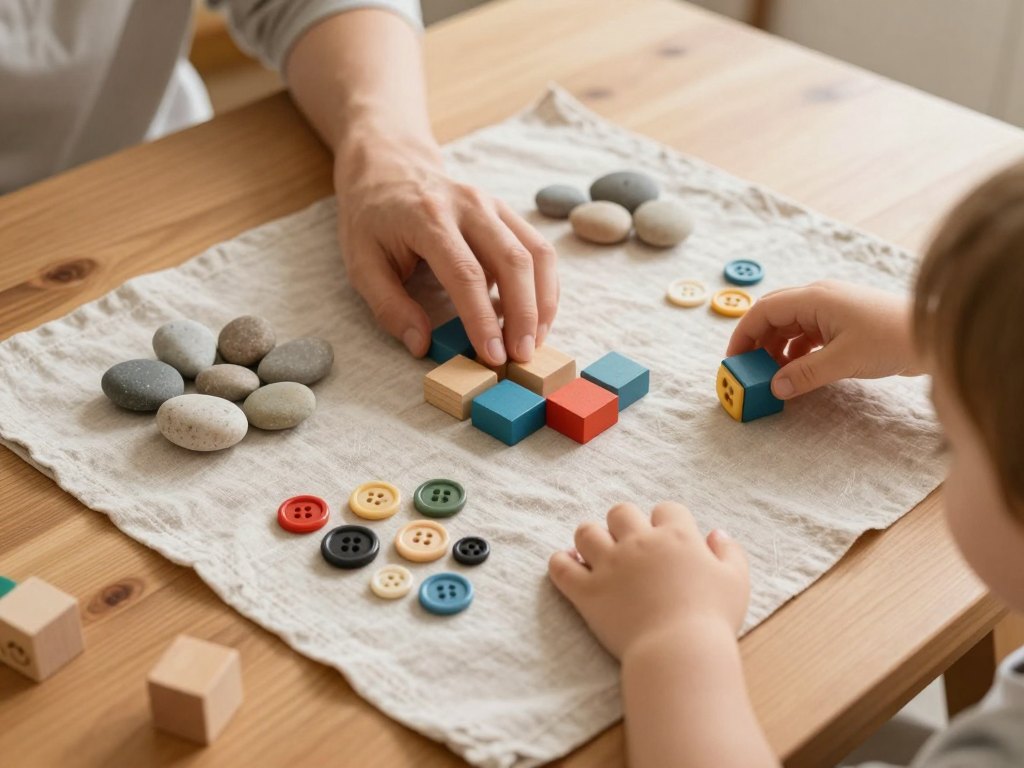
This programme starts from a different idea. Children learn best when they move, listen to stories, handle real objects and play. A number is far easier to understand when it is a step on a path, a block in a tower or a character in a tale than when it is a symbol in a row of exercises.
The course gives you the practical side of that idea. Video lessons show you how to set up a game, what to say, which questions to ask and how to adjust the task when it turns out too easy or too hard. You do not need teaching experience or a shelf of special equipment to follow along.
The method works with preschoolers and younger school children. It covers arithmetic, spatial thinking, logic and the first steps in reading, so you can return to the lessons as your child grows and as new questions appear.
What you will be able to do
After working through the lessons you will be able to:
- Run a short maths game session at home
Prepare it in minutes and finish while your child still wants more.
- Explain counting and arithmetic through play
Use movement, stories and everyday objects instead of drills.
- Play logic games without any props
Use pencil and paper or just conversation, in the car or in a queue.
- Introduce geometry and spatial thinking
Work with shapes, patterns, cubes and drawing on a grid.
- Support early reading with word games
Help your child become comfortable with letters, sounds and words.
- React calmly to mistakes
Turn a wrong answer into a question that moves the game forward.
- Adapt a task to your child's age and mood
Make it simpler or harder without stopping the play.
- Build a regular, relaxed family routine
Keep the habit going through holidays and busy weeks.
- 6
- modules
- 24
- video lessons
- 5–10
- age range of the games
- 14 days
- refund window
The idea behind the games
The programme is built on a play-based approach to teaching preschoolers and younger school children. Instead of asking a child to sit still and complete a page of sums, the games bring in movement, fairy tales, visual materials and small puzzles. The child is busy with the game, and the maths happens inside it.
This matters because young children do not separate learning from playing. A task that has a story, a goal and a little suspense holds their attention far longer than the same task written on a worksheet. It also lowers the fear of getting things wrong, since a wrong move in a game is just another move.
Many of the activities need nothing more than a sheet of paper, a pencil and a bit of conversation. Others use simple visual materials such as blocks, cubes or shape grids. The lessons show you both kinds, and tell you which are useful at the kitchen table and which at the bus stop.
You are not expected to copy every game exactly. The aim is to help you see the logic of the approach, so that you can invent your own variations and notice what your child finds funny, hard or exciting.
How the course works
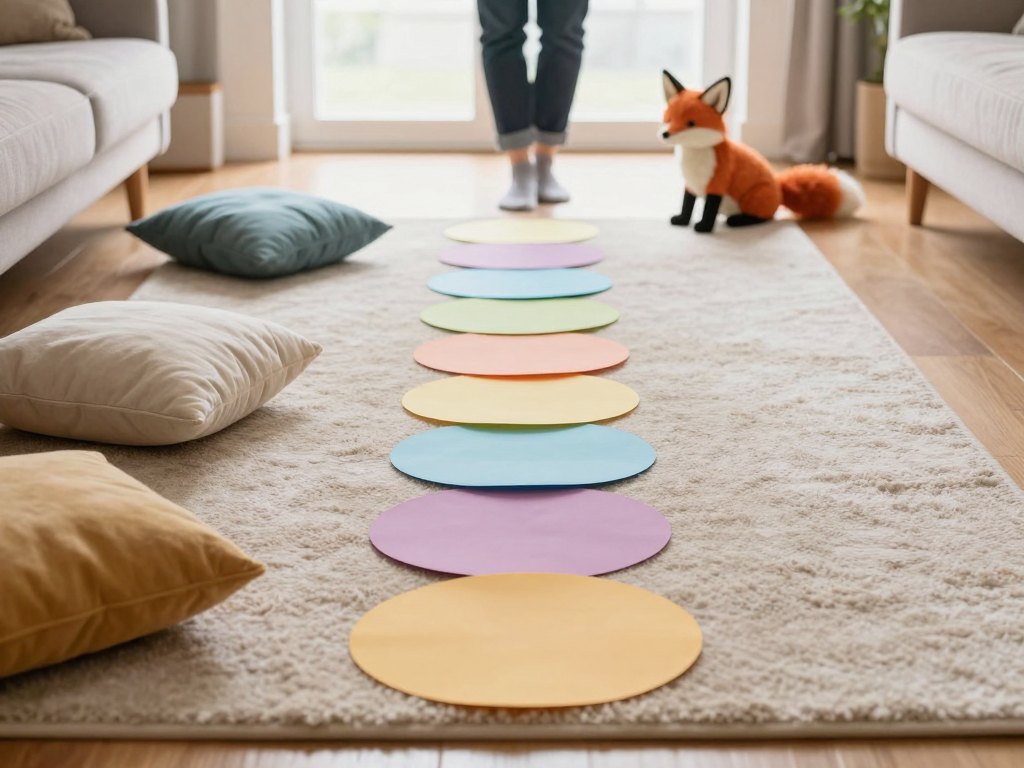
The course is a self-paced video programme. You can start whenever you like, watch a lesson in one sitting and then try the game with your child the same day. Each lesson shows a game in action, explains its purpose and suggests how to vary it, and comes with ready-made tasks you can use straight away.
The programme is divided into six modules that follow a natural order: first the basics of playing together, then arithmetic, logic, geometry and words. You can go in sequence or jump to the topic your child needs right now. Lessons are short enough to fit into an evening, and the games themselves are designed for short sessions.
Because there are no fixed deadlines, you set the pace. Some families play a game a day, others once a week. Everything stays available, so you can come back to a lesson when your child reaches the next stage or asks for a favourite game again.
The programme
Six modules, from the first game to your own family routine. You can follow them in order or choose the topic that fits your child today.
1Module 1 — Learning to play maths togetherThe basics of running a relaxed, enjoyable game session.4 lessons
- Why play works better than drills for young children
- Setting up a short game session at home
- Choosing a game for your child's age and mood
- Talking about mistakes without pressure
2Module 2 — Arithmetic through playCounting, adding and subtracting with movement, stories and objects.4 lessons
- Counting games for preschoolers
- Building number sense with visual materials
- Addition and subtraction stories
- Arithmetic games for the first years of school
3Module 3 — Arithmetic on paper and aloudGames and tasks you can play with a pencil, or with no props at all.4 lessons
- Mental arithmetic games for the car or the queue
- Number puzzles on a sheet of paper
- Turning a simple sum into a challenge
- Tasks that grow with your child
4Module 4 — Logic games and puzzlesReasoning, patterns and problem solving without any equipment.4 lessons
- Logic games you can play aloud
- Pencil-and-paper logic tasks
- From simple word problems to harder ones
- Helping a child who gets stuck
5Module 5 — Geometry and spatial thinkingShapes, building and drawing to train the eye and the hand.4 lessons
- Geometric puzzles for preschoolers
- Building with cubes and other blocks
- Drawing shapes and patterns on a grid
- Games that train fine motor skills
6Module 6 — Words, speech and first readingLanguage games that support vocabulary and a calm start with letters.4 lessons
- Word games for speech development
- Playing with sounds and letters
- Helping a child who finds reading difficult
- Making a weekly family game routine
What you get
- 24 video lessons
Detailed instructions showing each game in action.
- Ready-made tasks
Games and exercises you can use immediately.
- Games that need no props
Ideas for home, the road and any waiting time.
- Guidance on adapting tasks
Tips for making a game easier or harder.
- Learn at your own pace
Start whenever you like and pause when life gets busy.
- Lifetime access
Return to any lesson as your child grows.
- 14-day refund
If the course is not right for you, ask for your money back.
Is this course for you?
This course is for you if…
- Parents of preschool and primary-school children who want a calm way to practise maths at home
- Grandparents and carers who spend time with children and want new games to play
- Parents whose child is worried about maths and needs a fresh, friendly start
- Anyone who likes to learn by watching a demonstration and then trying it
Probably not a fit if…
- Those who want a school curriculum with grades and tests
- Families looking for one-to-one tutoring or personal feedback on their child
- People who expect a quick fix without regular play
- Parents of teenagers preparing for advanced exams
After the course
After the course you will have a collection of games you know well and can start in under a minute. A walk to the shop, a long drive or a rainy afternoon becomes a chance to play with numbers, shapes and words rather than a reason to reach for a screen.
You will also feel more relaxed about maths. Instead of correcting your child, you will ask questions, wait, and let them find the answer. Many parents find that this changes the atmosphere around homework as well.
Most importantly, your child will have the experience of maths as something enjoyable. That experience is a strong foundation for everything that comes later at school.
Questions before you buy
How much time do I need each week?
It is up to you. The games are designed for short sessions, so ten to twenty minutes a few times a week is enough. Lessons can be watched in one evening and tried with your child the next day.
Do I need any prior knowledge or special equipment?
No. You do not need teaching experience or advanced maths. Many games need only paper, a pencil and conversation. Where simple materials such as blocks or cubes are used, the lessons explain what to use.
How old should my child be?
The programme is aimed at preschoolers and younger school children. The games are suitable for roughly the 5–10 range, and the lessons show how to simplify or extend each task.
How does access work after I pay?
Once your payment is confirmed you receive access to the course and can begin straight away. You can watch on a computer, tablet or phone whenever it suits you.
What format are the lessons in?
They are self-paced video lessons with detailed instructions, accompanied by ready-made tasks and materials you can use in your own games.
Will the material stay available?
Yes. You can return to any lesson whenever you like, so the course grows with your child.
What if the course is not right for me?
You can request a full refund within 14 days of purchase, with no need to justify your decision.
Can I follow the modules in any order?
Yes. The first module is a good place to begin, but you can jump to arithmetic, logic, geometry or words depending on what your child needs.
Start playing maths this week
Pick the first lesson, choose a game and see how your child responds.