Wellbeing · All levels
Build a calm, steady daily qigong practice at home
Follow a large library of narrated video lessons and theory lectures, from first breathing exercises to stepping, standing and seated practice.
- 123 video lessons
- 25 theory lectures
- Lessons of 20–90 minutes
- New practices added regularly
- 14-day refund policy
Why qigong works so well as a video course
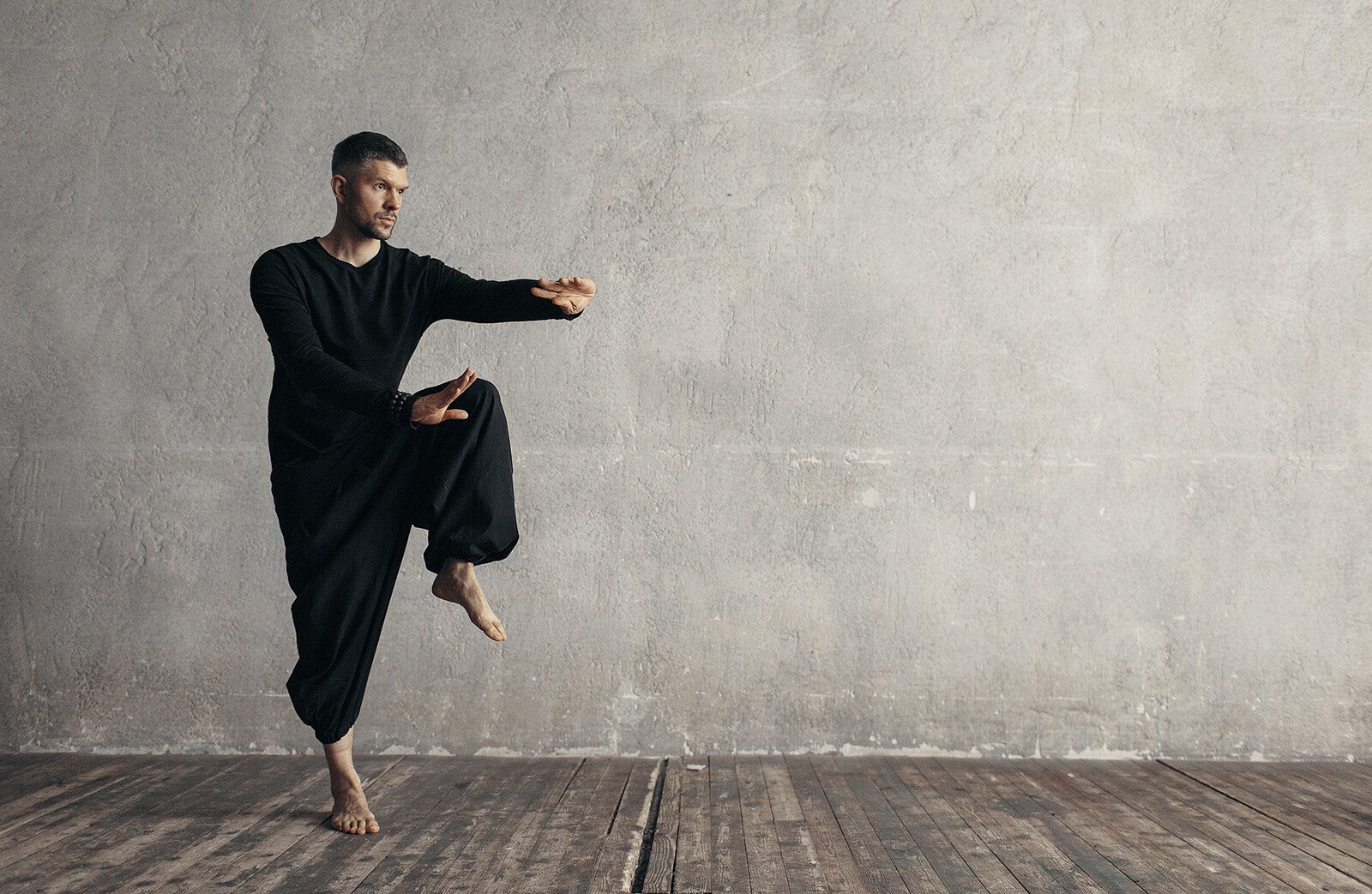
Qigong is a Chinese system of slow, flowing movement, breathing and attention that has been practised for more than a thousand years. It is also the foundation of taijiquan, which grows out of the same principles. Many people feel drawn to it because it looks gentle, yet they struggle to find a class that fits their schedule, their city or their level.
Learning from a book or a short clip rarely works. Qigong is made of details: where your weight sits, how a wrist turns, when you inhale. Without someone explaining each movement while you do it, it is easy to copy the shape and miss the point.
This programme solves that problem. Every movement in the lessons is explained aloud as it is performed, so you can watch the details, pause, rewind and repeat a favourite session as often as you like. Many people also prefer to practise in private at first, without the pressure of keeping up with a group.
The practice is based on the Hunyuan Taiji tradition, which treats movement and stillness as two sides of one training. It develops the inner and outer body together, with the emphasis on calm and internal awareness. You do not need special clothes, equipment beyond a simple stick, or more than one or two square metres of floor.
What you will be able to do
Skills and habits you build as you move through the library.
- Perform a basic qigong session
Start with introductory practice and foundational exercises, then build to longer routines.
- Coordinate breath and movement
Learn abdominal, spherical and column-based breathing and how each links to posture.
- Use silk-reeling movements
Practise the winding, spiralling motion at the heart of the style, in place and in steps.
- Walk and turn with balance
Work on free steps, horse stance, slow turns and the principles behind a well-built step.
- Practise standing and seated qigong
Choose exercises that suit the space, time and energy you have on a given day.
- Explain the theory behind the exercises
Understand attention, internal work, force application and partner work through the lectures.
- Link short exercises into longer routines
Combine short pieces into complete sessions that fit your own schedule.
- Keep a regular practice going
Use a library big enough to vary your sessions week after week.
- 123
- video lessons
- 25
- theory lectures
- 20–90 min
- per lesson
- 6
- practice modules
Every movement explained aloud
The signature feature of the lessons is the running commentary. Each exercise is demonstrated slowly while its mechanics are described: how the feet are placed, where attention goes, how the breath follows the motion.
A recording lets you work in a way a crowded hall cannot. You can pause at a single posture, replay a transition that confused you, and return to an exercise a month later when you understand more. The same lesson will teach you something different at each stage.
- Slow, smooth movements that need no special physical ability
- Space of only 1–2 square metres
- Ordinary clothes are fine
- Pause, rewind and repeat any lesson
How the course works
The programme is a library of recorded video lessons and lectures that you watch online. All lessons are available as soon as your payment is confirmed, so you decide where to start and how fast to go. Lessons last from 20 to 90 minutes, which makes it easy to pick a short session on a busy day and a long one at the weekend.
The material is organised by type of practice. Theory lectures explain the principles, the stick-based practices form the largest block, and further modules cover practice without the stick, thematic sessions and qigong systems. You can follow the order we suggest or choose by mood and energy. New practices are added to the library regularly.
The lessons are intended for online viewing and cannot be downloaded. Access is a subscription, so choose the period that suits your rhythm. A simple wooden tai chi stick is used in many lessons, and a rolled magazine, a rolling pin or a water bottle works as a substitute.
The programme
The library is arranged in six modules. New lessons keep being added, so the number of titles grows over time.
1Module 1 — Theory lecturesTwenty-five lectures that explain the ideas behind the practice.25 lectures · 20+ hours
- Breath and attention (with a written version of 18 pages)
- Internal work and the key points of the body
- The art of steps
- Applying force
- Partner work
2Module 2 — Qigong with the stick: foundationsFirst practices, basic exercises and small-style routines.40+ lessons
- Introductory practice
- Basic exercises
- Qigong for the feet
- Small-style qigong
- Winding the silk thread
- Principles of building a step
3Module 3 — Stepping and turningMoving through space while keeping your centre.Video lessons
- Free steps
- Slow turns
- Diagonal winding
- Breathing and twisting
- Dynamic qigong in steps
- Horse stance steps and the eight-trigram step
4Module 4 — Standing and seated practiceQuieter work for breath, posture and attention.Video lessons
- The pillar stance of the Hunyuan school
- Spherical breathing
- Seated exercises for the centre of the body
- Seated meditation: uniting the three treasures
- Abdominal breathing lying down
- Mountain walking
5Module 5 — Qigong without the stickDynamic exercises for hands, spheres and forms.Video lessons
- Dynamic qigong
- Focusing on the palms in a wide stance
- The art of stroking the wall
- Rotating eighteen spheres
- Twenty-four Hunyuan Taiji forms in one practice
- Taiji forms in sequence
6Module 6 — Complexes and systemsLonger sessions that combine shorter exercises, plus new themed blocks.Video lessons
- Fourteen comprehensive themed lessons
- Six harmonies seated complex
- Qigong in systems: seasons, elements, emotions and movement
- Qigong massage of the internal organs
- Qigong exercises with a club
- Building your own routines
What you get
- 123 video lessons
Each from 20 to 90 minutes, with the movement explained aloud.
- 25 theory lectures
Explanations of breath, attention, steps, force and partner work.
- Written material
A text version of the first lecture runs to 18 pages.
- Instant access
All lessons open as soon as your payment is confirmed.
- New practices
The library keeps growing with fresh lessons and themes.
- Flexible pace
Watch when you want, as often as you want, from any city.
- Online viewing
Stream on your computer, tablet or phone while your access is active.
- 14-day refund policy
You can ask for a refund within 14 days of purchase.
Is this course for you?
This course is for you if…
- You are new to qigong and want a patient, step-by-step start.
- You already practise qigong or taiji and want a wider library of exercises and theory.
- You want gentle, low-impact movement that suits almost any age.
- You prefer to practise at home, in your own time, with detailed commentary.
- You enjoy dance, martial arts or sport and want slow movement to refine your control.
Probably not a fit if…
- You want downloadable files to keep offline; the lessons are for streaming only.
- You are looking for fast, high-intensity workouts.
- You expect a medical treatment or a guaranteed health outcome.
- You want live feedback on your technique from a teacher.
After the course
Within a few weeks of regular practice you will have a repertoire of exercises you can do without watching the screen: a short routine for the morning, a seated sequence for a work break and a longer session for the weekend.
You will understand why you do each movement, not just how. That makes practice more focused, and it makes it easier to adapt exercises to your own body and to the time you have.
Because the library is large and growing, there is always a next step. Many people use it for months or years, returning to earlier lessons with a fresh eye. Qigong is a gentle practice, not a cure, so approach it with patience and consult your doctor if you have a medical condition.
Questions before you start
How much time do I need each week?
There is no required schedule. Lessons run from 20 to 90 minutes, so you can do a short session most days or a longer one a few times per week.
Do I need any experience or a certain age?
No. The programme suits beginners and continuing students alike, and the exercises are soft and flowing, with no special physical requirements. People start at any age.
How does access work after payment?
All lessons open as soon as your payment is confirmed. A one-month subscription runs for 30 days from the day you pay, and longer plans are available.
Is there a refund policy?
Yes. You can ask for a refund within 14 days of purchase if the course does not suit you.
What format are the lessons in?
They are recorded video lessons with spoken commentary on every movement, plus lectures, one with an accompanying 18-page text.
Can I download the videos?
No. The lessons are available for online viewing only, on any device with an internet connection.
Will the material stay available?
The lessons stay available for as long as your access period is active, and you can watch them as many times as you like in that time.
Do I need equipment?
Many lessons use a tai chi stick. If you do not have one, a rolled magazine, a rolling pin or a water bottle can stand in for it.
How much space do I need?
Only one or two square metres. The movements are smooth and small in amplitude, so ordinary clothing is fine.
Take your first lesson this week
Choose your access period and start practising qigong at home at your own pace.