Communication · All levels
Look natural on camera and deliver your words with confidence
An online presenting programme that teaches you to hold yourself in front of the lens, write your own texts and present them clearly.
- Self-paced video lessons
- Practical speaking exercises
- Access right after payment
- 14-day refund policy
Why being on camera feels so hard
Most people know exactly what they want to say, and then lose it the moment a camera is switched on. The voice tightens, filler sounds creep into every sentence, the hands do not know where to go, and the body suddenly feels like it belongs to someone else. If this sounds familiar, you are in very good company, because almost everyone feels this way at the start.
Television and digital media reward people who look relaxed, speak clearly and bring their own ideas to the screen. Those skills are not a gift handed out at birth. They are habits of posture, breathing, phrasing and preparation, and they can be trained step by step. The difficulty is that few courses break them down into small, practical exercises you can repeat at home.
This programme brings together the core craft of presenting: how to stand and move in the frame, how to train your voice and diction, how to write a text that sounds like speech, and how to deliver it without sounding read from a page. It also looks at what live airtime demands, and how to keep a steady head when there is no chance for a second take.
You work at your own pace, record yourself, compare the results and improve one habit at a time. By the end, being in front of a lens should feel like a skill you own rather than a test you are trying to survive.
What you will be able to do
- Hold yourself naturally in front of a camera
Use posture, gesture and eye contact that look relaxed rather than staged.
- Write texts meant to be spoken
Build short sentences and a rhythm that works when read aloud.
- Deliver a script without sounding read
Apply techniques that make you sound like you are talking, not reciting.
- Reduce filler sounds and crutch words
Replace pauses of uncertainty with clean, confident stops.
- Control your voice and diction
Use warm-ups for articulation, breath and the speech apparatus.
- Prepare for a live broadcast
Understand what live airtime demands and how to stay calm.
- Train your memory and reaction
Practise the quick thinking that keeps you fluent when plans change.
- Review your own recordings critically
Follow a simple checklist for spotting and fixing weak points.
- Choose a style that suits your personality
Find a presenting manner that feels like you and not like an imitation.
- 6
- modules
- 26
- video lessons
- 14 days
- refund window
The method: practise by recording yourself
The central method of the course is a simple loop. You watch a lesson, do the exercise, record a short clip on your phone and review it against a checklist. Then you repeat the exercise and compare the new clip with the old one. This loop is repeated in every module, so the habit of looking at your own work becomes automatic.
Seeing yourself on video is uncomfortable at first, but it is the fastest way to notice habits you cannot feel while speaking: a raised shoulder, a swallowed ending, a repeated filler sound, a gaze that drifts away from the lens. Once you can name a habit, you can work on it, and the lessons give you specific drills for each one.
Over the weeks, the clips you collect become a record of real progress. Many learners find that comparing their first and latest recordings is the most convincing proof that the practice works, far more than any promise made in advance.
How the course works
The course is delivered online as a library of video lessons with practical tasks. You get access straight after payment and can study whenever it suits you, in the evening, at the weekend or in short sessions between other commitments. There are no fixed class times and no deadlines to keep up with.
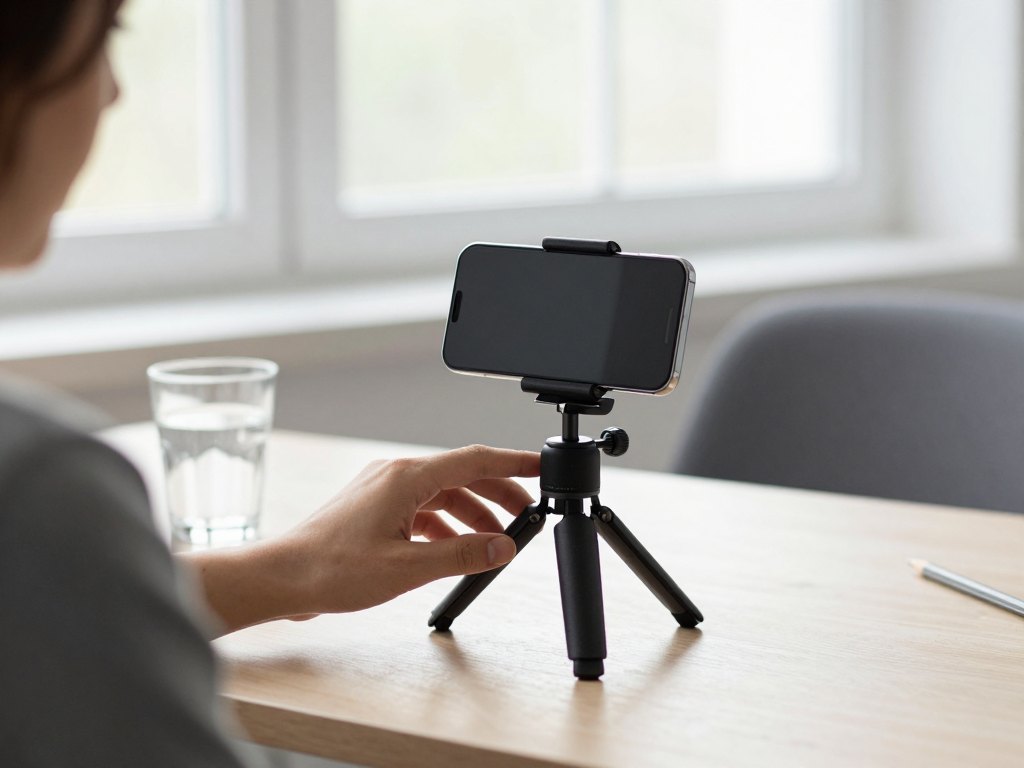
Each module combines short explanations with exercises. You do not need studio equipment: a phone, a quiet corner and a little regular time are enough. The tasks are designed to be done at home, from articulation warm-ups in front of a mirror to recording a short segment and watching it back.
Because the programme is self-paced, you can move quickly through topics you already know and return to the harder ones, such as speaking without filler words, as often as you like. The lessons are meant to be used as a working toolkit, not watched once and forgotten.
The programme
Six modules that take you from first nerves to confident delivery.
1Module 1 — First steps in front of the lensUnderstand what the camera sees and how to settle into it.4 lessons
- How the camera changes the way you look and sound
- Posture, hands and eye contact
- Managing nerves before you record
- Your first test clip and how to review it
2Module 2 — Voice and dictionTrain the voice as a working tool.5 lessons
- Breathing and voice support
- Articulation warm-ups
- Diction exercises for clear speech
- Tempo, pauses and intonation
- Building a five-minute daily voice routine
3Module 3 — Speaking without a teleprompterSound natural and drop the filler words.4 lessons
- Why filler words appear and how to remove them
- Training memory and reaction
- Speaking as if it were written
- Practice: a one-minute talk without notes
4Module 4 — Writing for the screenCreate texts that work when spoken aloud.5 lessons
- Spoken language versus written language
- Structure of a short on-screen text
- Opening lines that hold attention
- Closing lines that land
- Editing your own script by ear
5Module 5 — Presenting live and recordedKnow the demands of each format.4 lessons
- What a live broadcast requires
- Staying calm under pressure
- Recorded segments and retakes
- Reacting when something goes wrong
6Module 6 — Your own styleBring everything together into a manner that is yours.4 lessons
- Finding your presenting manner
- Style, clothing and appearance on screen
- Reviewing your recordings with a checklist
- Building a short practice routine for the future
What you get
- Video lessons across six modules
A structured path from first nerves to confident delivery.
- Practical exercises for voice and diction
Warm-ups and drills you can repeat as often as you need.
- Script-writing tasks
Short assignments that turn ideas into spoken text.
- A self-review checklist
A clear list of points to check in each of your recordings.
- Access straight after payment
Start the first lesson the same day.
- Lessons you can revisit at any time
The material stays available for you to return to.
Is this course for you?
This course is for you if…
- Beginners who dream of presenting on television or online and want a safe place to start
- Bloggers and video makers who want to look and sound more natural on camera
- Professionals who speak in public, in meetings or on video as part of their work
- Anyone who wants clearer, calmer and more confident speech in everyday life
- Students of media and journalism who want practical speaking skills alongside theory
Probably not a fit if…
- People looking for one-to-one coaching or live personal feedback
- Those expecting a guaranteed job or a place on television
- Anyone who does not want to record and review themselves
- Learners who want a live, in-person studio experience
After the course
You will be able to switch on a camera and speak without the usual tension. Your posture, voice and wording will be more deliberate, and you will have a routine for keeping them sharp. Filler words will no longer take over your sentences, and pauses will start to work for you instead of against you.
You will also be able to write your own short texts for video and deliver them in a way that sounds natural rather than read. That means you can prepare a segment, a presentation or a short video of your own without depending on someone else to give you the words.
The recordings you made along the way will show how far you have come, and the checklist and exercises remain with you as a toolkit. When a new situation comes up, such as a live appearance or a new format, you will know how to prepare for it and how to review your own performance honestly.
Questions before you buy
How much time do I need per week?
The course is self-paced, so you decide. Many learners set aside a few hours a week for watching lessons, doing exercises and recording a short clip. You can go faster in a busy-free week or slow down when life gets full.
Do I need any experience?
No. The programme starts from the basics and suits complete beginners, and it is also useful to people who already work on camera and want to polish their habits.
How does access work after payment?
You get access right after payment. You can open the first lesson the same day and study in whatever order and at whatever pace suits you.
What is the refund policy?
You can request a refund within 14 days of purchase. If the course does not feel right for you, contact support within that window and the payment will be returned.
What format are the lessons in?
The lessons are self-paced video lessons with practical tasks and a review checklist. You can watch them on a computer, tablet or phone.
Will the material stay available?
Yes. You can return to the lessons whenever you need them, for instance to repeat the voice exercises before an important recording.
Do I need special equipment?
No. A phone camera and a quiet place are enough for all the exercises. A mirror helps with the articulation warm-ups, but nothing else is required.
Is there personal feedback from teachers?
The course is self-paced and does not include one-to-one coaching. You review your own work using the supplied checklist, which is designed to help you notice what to improve.
Will the course get me a job on television?
No course can promise that. The programme teaches practical skills in presenting, writing and delivery, which you can then use in whatever direction you choose.
Start speaking with confidence
Begin the lessons today and record your first clip this week.