Creative · Beginner
Start drawing neurographic pieces with a clear, repeatable method
Nine webinars take you from your first line to confident drawing. You get feedback on your work and recordings to return to whenever you like.
- 9 webinars
- Feedback on your drawings
- Recordings kept
- No drawing skills needed
- 14-day refund
Why a good start matters
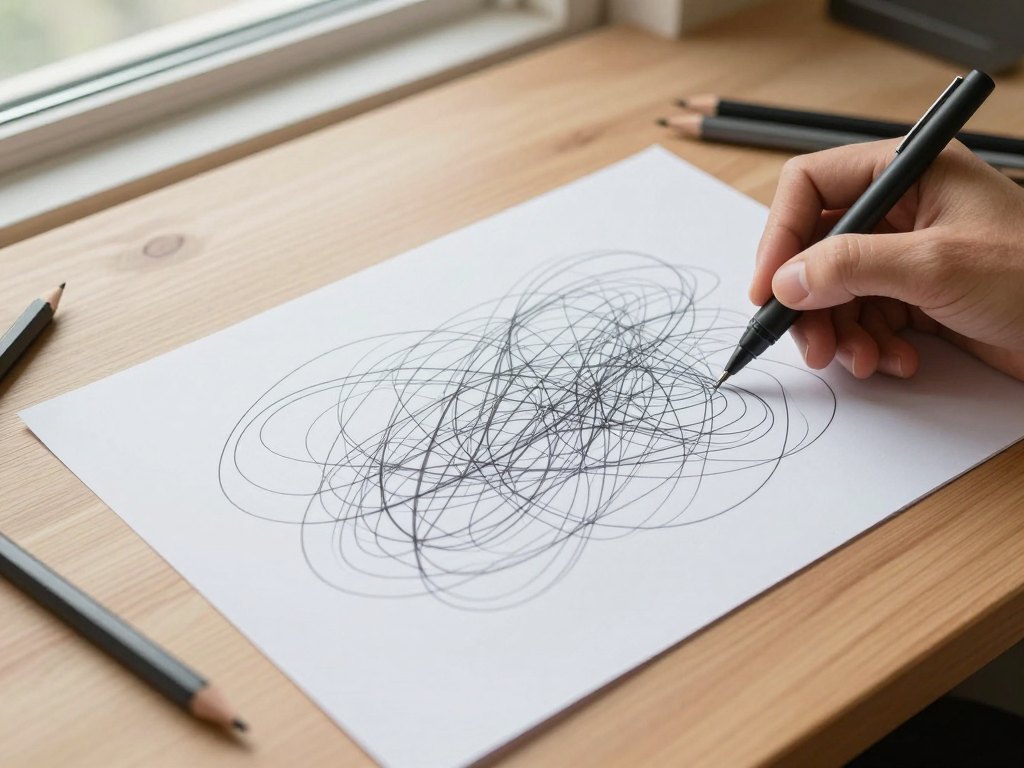
Neurographic drawing looks simple. You put a few lines on paper, round the corners, and colour the result. Many people try it once from a free video and then stall. They are not sure whether they are doing it correctly, why the same exercise feels different each time, or how to choose a topic for a drawing.
The usual gap is the base: the order of the steps, the reasoning behind each one, and a calm pace of working. Without it, every drawing feels like a guess. With it, you know what you are doing at each stage, and the page stops being intimidating.
This programme is built for people who have not yet drawn with the method. It starts with the very first principles and builds one step at a time. You do not need artistic talent. You need paper, a pen, some markers or pencils, and the willingness to slow down for the length of a drawing.
By the end you will have a working process of your own. You will be able to choose a theme, start a drawing, finish it and reflect on what it showed you.
What you will be able to do
- Explain what neurographic drawing is
You will understand the idea behind it in plain terms, without jargon.
- Prepare a calm workspace and the right materials
You will know what you need and how to set up a session.
- Start a drawing from a theme or a question
You will frame a topic so that the drawing has a clear purpose.
- Draw a contour and link its lines
You will follow the basic algorithm in the correct order.
- Round the sharp corners deliberately
You will learn why this step matters and how to do it smoothly.
- Fill a drawing with colour and texture
You will make considered choices rather than random ones.
- Read your own drawing afterwards
You will practise noticing what the finished piece shows you.
- Build a regular drawing habit
You will leave with a simple routine you can keep up.
- Take feedback and improve
You will learn from comments on your own work.
- 9
- webinars
- 4
- modules
- 1
- clear base algorithm to practise
- ∞
- access to the recordings
The method behind the course
Neurographic drawing is a reflective practice. You draw a theme that matters to you using a fixed sequence of simple steps, and you pay attention to how you feel while doing it. The drawing becomes a way to look at a situation from a slightly different angle, rather than a piece of art to be judged.
The course follows that sequence from the beginning. Each webinar adds one layer to the process: first the basics, then the core algorithm, then colour and composition, then regular practice. Nothing is skipped and nothing is assumed.
The lessons keep a slow, quiet rhythm. You draw as you listen, so the method is learned through doing and not only through theory. Beautiful results are welcome, but they are a side effect of working attentively and not the goal of any single exercise.

How the course works
The programme is made up of nine webinars, taught as live broadcasts with a recording kept for you. If you cannot attend a session, you watch the recording and still do the exercises. You keep access to the lessons with no time limit, so you can return to any part later.
Your drawings are reviewed. After each practical task you can submit your work and receive feedback, which is the part that helps most people see what to adjust. The comments focus on the process and on getting the steps right, not on how artistic the result looks.
You work at your own pace between sessions. Each webinar has a drawing task, and the time you spend on it is up to you. A comfortable rhythm for most people is a session plus one or two quiet drawing evenings during the week.
Everything you need is simple and cheap: plain paper, a black pen or fineliner, and a set of coloured markers or pencils. No special software or equipment is needed.
The programme
Nine webinars in four modules, taught in order. Each module builds on the previous one.
1Module 1 — First principlesWhat the method is and how to prepare for it.3 webinars
- What neurographic drawing is and how it is used
- Materials, workspace and a calm way of starting
- Your first drawing, step by step
2Module 2 — The core algorithmThe fixed sequence that every drawing follows.2 webinars
- Choosing a theme and framing a clear question
- Drawing the contour, linking lines and rounding corners
3Module 3 — Colour and compositionMaking considered choices about how a drawing looks.2 webinars
- Colour choices and filling the shapes
- Texture, balance and finishing touches
4Module 4 — Practice and reflectionTurning single drawings into a habit.2 webinars
- Reading a finished drawing and noting what it shows
- Building a regular routine and choosing your next themes
What you get
- Nine webinars
Live broadcasts with a recording kept for you.
- Drawing tasks
A practical exercise attached to each webinar.
- Feedback on your drawings
Review of submitted work so you can correct and improve.
- Access with no time limit
Return to the lessons whenever you want to practise again.
- A simple materials list
Everything you need is easy to find at home or in a shop.
- A repeatable process
A method you can apply to any theme after the course.
Is this course for you?
This course is for you if…
- You have never drawn with the neurographic method and want to learn from the basics.
- You tried a free video or two and want a structured path with feedback.
- You think you cannot draw and want an approach that does not need talent.
- You like quiet, creative practices that help you think about your own situation.
- You want to build a regular drawing habit that fits into your week.
Probably not a fit if…
- You are looking for a course on professional illustration or fine-art technique.
- You want a quick fix and are not willing to spend time drawing.
- You already work confidently with the method and want advanced material.
- You expect a promise of specific life results from drawing.
After the course
You will be able to sit down with paper and a pen, choose a theme, and draw a complete neurographic piece without hesitation. You will know what each step is for and in what order it comes.
You will also have a small collection of drawings you made along the way and notes on what you noticed in each. Many people find this record is the most useful part, because it shows how their attention and style change over time.
From here you can keep practising on your own, repeat any recording that you want to revisit, or move on to more specialised topics at your own pace.
Questions before you buy
How much time do I need each week?
Plan for the webinar itself plus one or two quiet drawing sessions between webinars. Because the recordings are kept, you can adjust the pace to your own week.
Do I need any drawing experience?
No. The programme is designed for people who have never used the method and do not consider themselves artistic.
What materials do I need?
Plain paper, a black pen or fineliner, and coloured markers or pencils. Nothing else is needed.
How does access work after I pay?
After payment you receive access to the programme. You can then follow the webinars and open the recordings whenever it suits you.
What is the refund policy?
You can ask for a refund within 14 days of purchase if the course is not right for you.
What format are the lessons in?
They are webinars delivered online. Each one has a recording, and each has a drawing task to complete afterwards.
Do I get feedback on my work?
Yes. You can submit your drawings and receive feedback focused on the process and the correct order of the steps.
Will the material stay available?
Yes. Access to the recordings has no time limit, so you can return to any lesson later.
Draw your first piece this week
Begin with the basics and build a method you can use for years.