Music · All levels
Become your child's first music teacher and learn alongside them
A membership club with video lessons, printable games and a piano programme adapted for parents, whether or not you have any musical training.
- Piano programme for ages 4+
- Printable games and workbooks
- New material every week
- Works without musical training
- 14-day refund policy
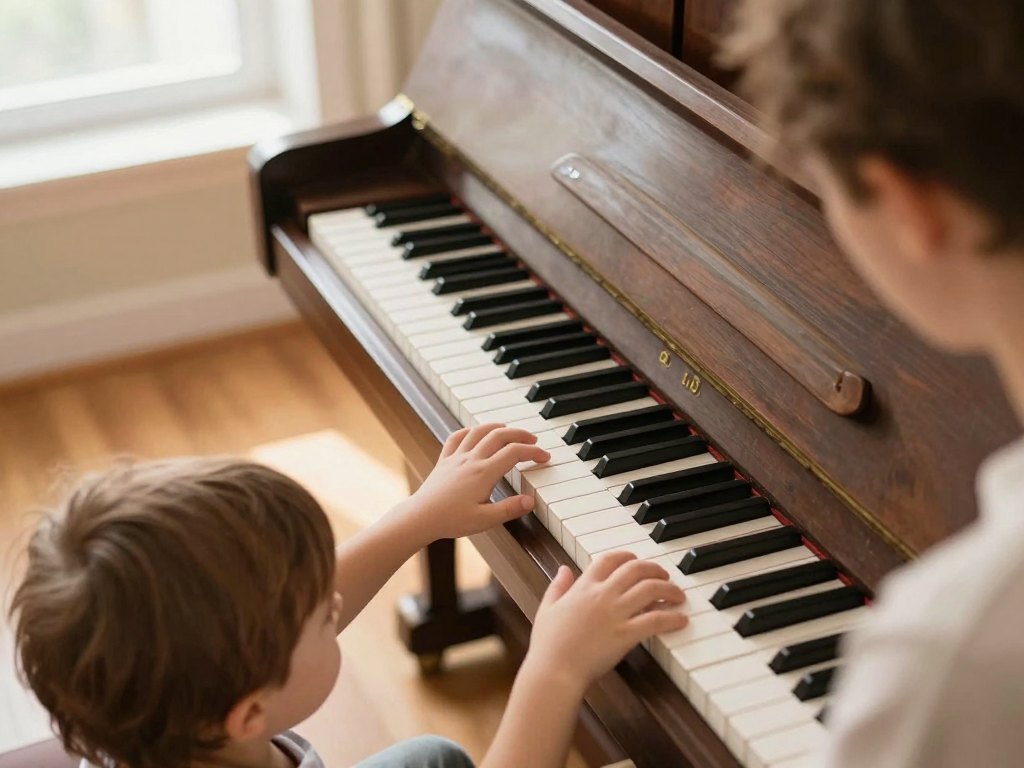
Why music so often stays in the cupboard
Many families have the same picture at home: a guitar in the corner, a flute in a drawer, a ukulele that was bought with the best intentions. The children are curious about instruments, yet the music rarely gets played, because nobody is quite sure where to begin.
Some parents know for certain that the strict path of a traditional music school is not what they want for their child. Others have no musical training at all and feel they have nothing to offer. Some can only play from printed notes and would love to give their children the freedom to invent. And in many homes, children who do have lessons slowly lose interest.
This club was created for exactly these situations. It treats music as something a family does together at home, as naturally as drawing, building or telling stories. You do not need to be a pianist. You need curiosity, a little time each week and the willingness to play.
Step by step, the lessons show you how to turn music back into a normal part of family life, how to teach small children without forcing them, and how to discover a new way of looking at music yourself.
What you will be able to do
Whatever your starting point, these are the abilities the club is built around.
- Start piano lessons with a child from age 4
Follow a lesson-by-lesson programme written so that a parent can lead it.
- Play simple music games with the whole family
Use instruments you already own, or no instruments at all.
- Introduce improvisation from the first lesson
Let your child invent music in every game and exercise instead of waiting for years.
- Teach music theory through board games
Reinforce each step of your child's development in a playful way.
- Make printable workbooks and notebooks
Build your own learning materials for you and your child.
- Play popular songs from specially designed notes
Use a songbook that works even without preparation, from age three to adulthood.
- Learn a connected system of musical knowledge
See how sound, numbers, geometry and physics fit together.
- Explain what you learn to your children
Pass on a whole-world view of music in clear, beautiful language.
- 6
- club sections
- 3 years
- covered by the piano programme
- Weekly
- new learning material
- 4+
- starting age for the piano programme
The idea behind the club
The club rests on two convictions. First, children learn best through play and through their own natural curiosity, not through pressure. Second, creating your own music is one of the most powerful ways to learn to express yourself and to become the author of your own story.
That is why improvisation is not saved for later. It is woven into the very first games and exercises, so that a child is always a creator and never only a performer of someone else's notes. The same idea applies to parents: you will not just repeat exercises, you will explore.
Many of the activities are inspired by years of working with children and adults who come to make music, write songs, create animated films and perform at family concerts. The warm family concert, where children play and sing their own pieces for their parents, is the spirit that runs through the whole club.
How the course works
After you join, you receive access to the club for one month. The membership renews automatically for as long as you want to remain a member, and you can contact support if automatic payments do not suit you. After registration, check your email for your login details, and look in the spam folder if the message does not appear.
You study at your own pace. The lessons combine video material, practical tasks, audio files with music for you to play along with, and files for printing. You do not need to follow a strict timetable: take a game one evening, a piano lesson at the weekend, a theory lesson when you have a quiet hour.
The club grows every week with new material, so there is always something fresh to try. You can also share your progress and talk with other members in the members' community, which is a good place to ask questions and see how other families are getting on.
Inside the club
The club has six sections. Content is added every week, so the library keeps growing while your membership is active.
1Section 1 — About the clubThe core ideas and how to prepare for your learning journey.3 lessons
- The foundations of the new approach to music education
- Preparing for the learning journey as a parent
- Smart notebooks: making workbooks for children and parents
2Section 2 — Little ones and keysA lesson-by-lesson piano programme for young children, adapted for parents and designed for the first three years.4 lessons
- An overview of the piano programme for small children
- Your child's first piece with a beautiful arrangement
- Using the parent diary: print it and follow the steps
- Learning to improvise from the very first lessons
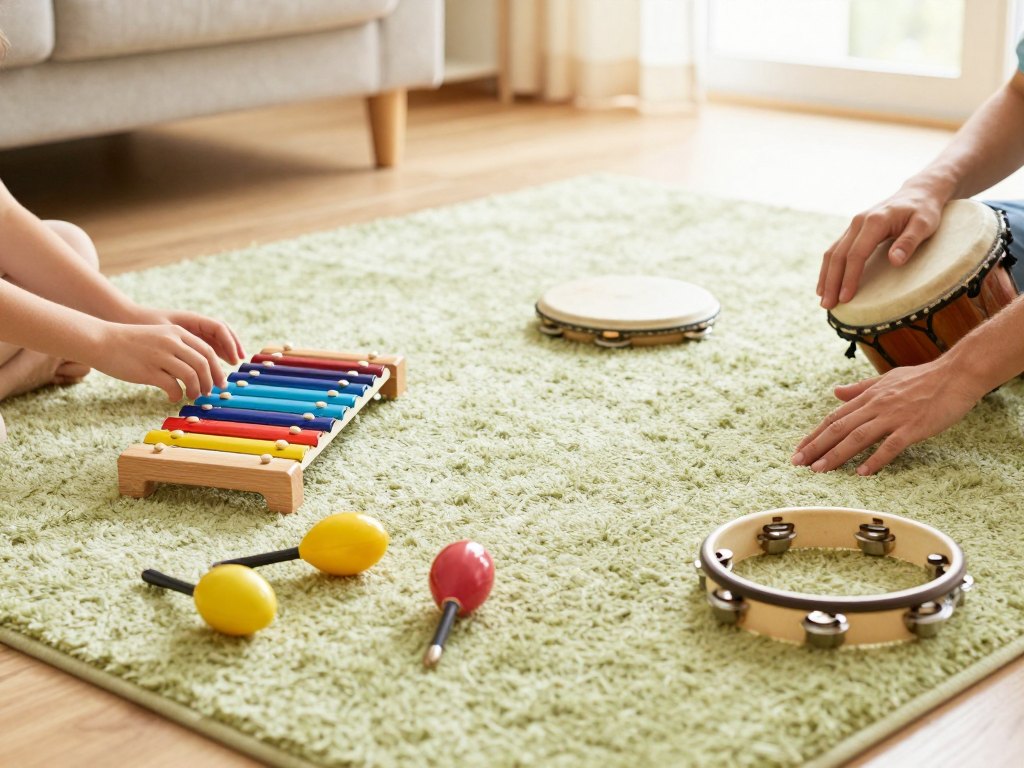
3Section 3 — Musical family gamesVideo instructions for games that develop general musicality, with any instruments or none.3 lessons
- Games you can play at home to develop every side of musical ability
- Playing with instruments you already own
- Music games without any instruments
4Section 4 — Board gamesA large collection of printable games that reinforce each step of your child's musical development.3 lessons
- How board games can teach the whole of music theory
- Print and play: first games for the whole family
- Choosing the right game for each stage
5Section 5 — The songbook "Play Without Rules"Notes for popular, much-loved songs that the whole family can use.3 lessons
- How the specially designed notes work
- Playing a favourite song with no preparation
- Family performances: from a three-year-old to an adult
6Section 6 — Universal laws of music for adultsLessons for grown-ups that join music, geometry, mathematics and physics into one system.4 lessons
- Sound, number and geometry as one picture
- Frequency and wave thinking about music
- Seeing how everything connects to everything else
- Telling children about it in a clear and beautiful way
What you get
Everything that is included in your membership.
- A piano programme for children from age 4
Written lesson by lesson and adapted so that a parent can teach it.
- A parent diary with step-by-step instructions
Print it and follow it at home.
- Many printable board games
First steps in music that the whole family can play.
- Original music for a child's first repertoire
Audio files to play along with.
- Improvisation in every game
A way of learning that carries over into everyday life.
- Descriptions of music games
For use with any instruments or without them.
- A series of lessons for adults
A connected system of musical knowledge from sound to numbers and physics.
- New material every week
The library keeps growing while your membership is active.
- A members' community
A place to share progress and ask questions.
Is this club for you?
This course is for you if…
- You have a preschool or primary-school child and want to take part in their musical education.
- You have musical training and want to try a freer, more natural way of teaching.
- You have no musical training at all but would love music to be part of your home.
- You own a piano, or any other musical instruments, and want to use them.
- You are a teacher who wants to apply play-based principles in one-to-one lessons.
Probably not a fit if…
- You are looking for personal tutoring or live one-to-one lessons.
- You want a strict, exam-focused music curriculum.
- You do not plan to spend any time playing together with your child.
- You prefer a one-off purchase rather than a monthly membership.
After the course
After a few weeks in the club, music has a regular place in your home. Instruments that used to sit unused are picked up for a game, a song or a short improvisation, and your child has a parent who plays along instead of watching from the side.
You have a clear first piece to learn together, a set of printed games on the table and a way to turn theory into something that feels like play. If you started with no musical background, you now have the confidence to guide your child through the early steps.
For many families, the biggest change is the atmosphere: music becomes a shared language, and a small family concert for friends and relatives is no longer a distant idea but a natural next step.
Questions before you join
How much time do I need each week?
There is no fixed schedule. Many parents spend a few short sessions a week, perhaps 20 to 30 minutes with their child, plus some time of their own to watch lessons. You can do more or less as your family prefers.
Do I need any musical training?
No. The club is designed for parents with and without musical training. If you already play, you will find new ways of teaching; if you do not, the lessons start from the very beginning.
Do I need a piano?
A piano or keyboard is ideal for the piano programme. If you do not have one, you can still use the music games, board games and other sections with any instruments you have.
How does access work after payment?
After registration you receive login details by email and get access to the club for 30 days. The membership renews automatically until you decide to stop. If automatic payments do not suit you, contact support.
What is the refund policy?
You can request a refund within 14 days of your purchase if the club is not right for you.
What format are the lessons in?
Lessons combine video, practical tasks, audio files with music, and printable files. You can watch whenever it suits you.
Will the material stay available?
All lessons and files stay available while your membership is active, and new material is added every week. Files you download and print are yours to keep using.
What age is the piano programme for?
It is written for children from 4 years old and covers the first three years of learning. The games and songbook can also be used with younger and older family members.
Can I take part if I am a teacher?
Yes. If you teach individually, you can use the play-based principles and games in your own lessons.
Bring music back home
Join the club and start with your first game this week.