Education · All levels
Understand what is really happening under your car's body
More than eight hours of 3D animation take you through the engine, transmission, suspension, brakes and electrics, with tests to check what you have learned.
- 8+ hours of 3D animation
- Self-check tests
- Self-paced video lessons
- 14-day refund policy
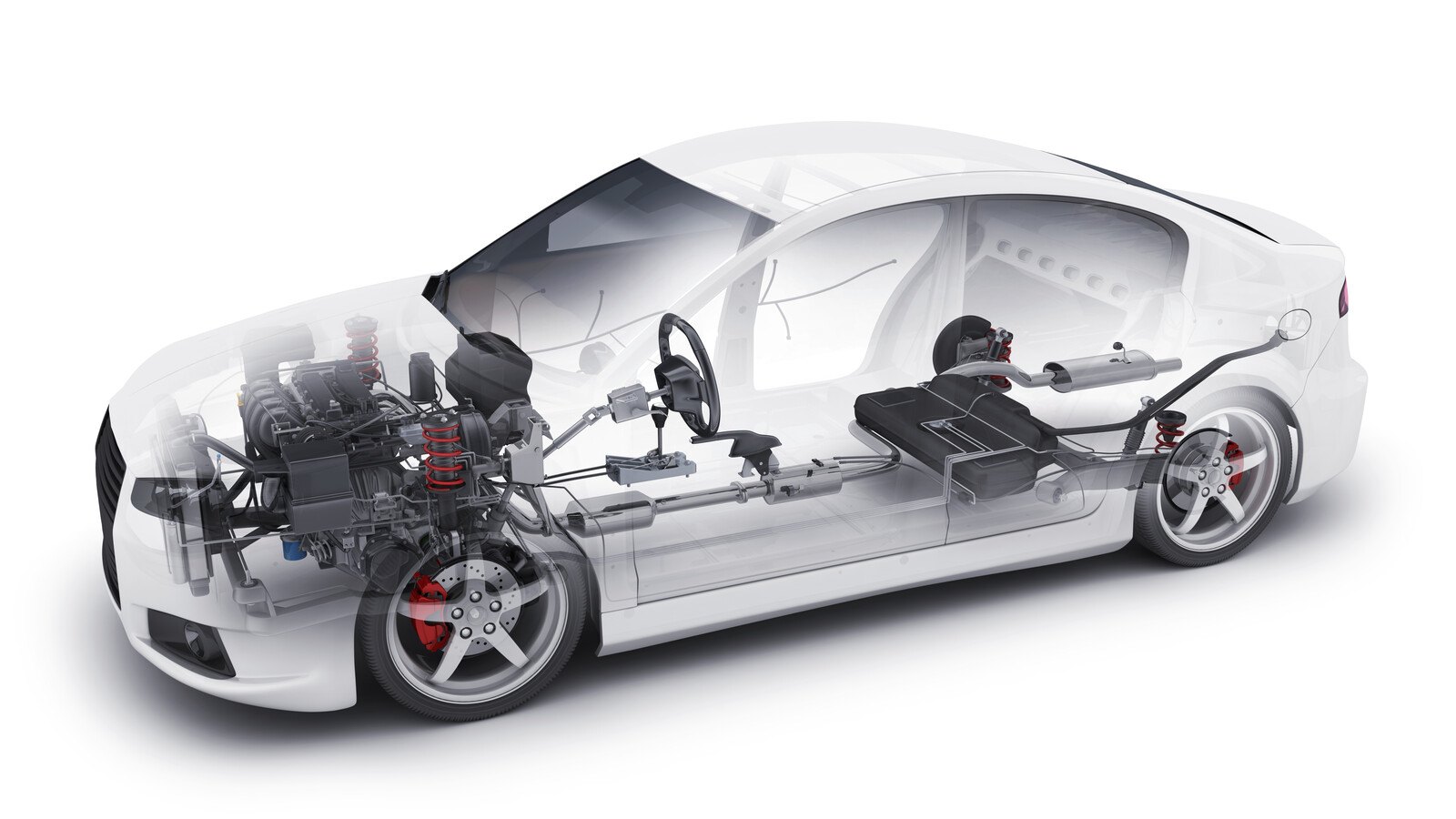
Most drivers use a machine they have never seen inside
You press the pedal, turn the wheel and the car responds. But what actually happens between your foot and the road is hidden behind panels, covers and a lot of metal. When a warning light comes on or a mechanic uses an unfamiliar word, it is hard to judge what you are being told.
Books on car construction are usually dense with diagrams that show a single flat cross-section. Real parts move, rotate, slide and work together, and that is very difficult to grasp from a still picture. Many people give up after a few pages and fall back on guesswork or on trusting whatever they hear.
This course takes a different route. Each system of a passenger car is shown as a transparent 3D model in motion, so you can see how a piston travels, how torque reaches the wheels and how the brake fluid pushes the pads. Explanations stay in plain language, and the terminology is introduced step by step.
By the end you will have a connected picture of the whole vehicle rather than a pile of isolated facts. That makes conversations at a service station, decisions about maintenance and even a used-car inspection far less intimidating.
What you will be able to do
- Name the main parts of a passenger car
Recognise the key assemblies and say where each one sits and what it does.
- Explain how an engine produces power
Follow the full cycle from fuel and air to rotation of the crankshaft.
- Describe how power reaches the wheels
Trace the path through clutch, gearbox, driveshafts and differential.
- Compare common suspension and steering designs
Understand why cars ride and handle the way they do.
- Understand how the braking system stops the car
See how pedal force becomes hydraulic pressure and friction.
- Read the logic of the electrical system
Know the roles of the battery, alternator, starter, sensors and control unit.
- Follow a mechanic's explanation with confidence
Ask better questions and understand the answers.
- Check your own understanding
Use the tests to find the topics that still need another look.
- 8+ h
- of 3D animation
- 6
- modules
- 25
- lesson topics
- Tests
- for self-checking
Learning by watching the mechanism work
The core of the course is the transparent 3D model. Body panels fade away and you look straight at the engine, suspension, brakes, exhaust and battery in their real positions. Parts are highlighted as they come into play, so your eye always knows where to look.
Instead of memorising lists of components, you watch cause and effect: the piston rises, the valve closes, the spark fires, the shaft turns. Repeating that logic across every system builds an intuition that stays with you.
- Animated cutaways of real assemblies
- One system at a time, then how they connect
- Terms explained when they first appear
- Tests after the topics to lock in the knowledge
How the course works
The course is a library of recorded video lessons that you watch online at your own pace. There are no live sessions you have to attend and no fixed deadlines, so you can fit it around work and family. Some people watch one topic in the evening, others work through a whole module on a weekend.
The modules follow the logic of the car itself. You begin with the overall layout and the body, then move to the engine, transmission, suspension and steering, brakes and exhaust, and finally the electrical equipment. Each module builds on the previous one, but you can return to any lesson whenever a topic needs a refresher.
Self-check tests accompany the material. They are meant for you, not for a grade: answer the questions, see where you hesitate and go back to the relevant animation. The whole programme adds up to more than eight hours of 3D animation.
The programme
Six modules that walk through a passenger car from the outside in.
1Module 1 — The car as a wholeThe big picture before the details.4 lessons
- The main assemblies of a passenger car
- Body types and the load-bearing structure
- Doors, glass and passive safety elements
- How the systems work together
2Module 2 — The engineFrom fuel and air to rotation.5 lessons
- The four-stroke cycle step by step
- Cylinder block, pistons and crankshaft
- Valve train and timing
- Lubrication and cooling systems
- Fuel supply and ignition
3Module 3 — The transmissionHow power travels to the wheels.4 lessons
- The clutch and why a car needs it
- The manual gearbox and its gears
- Automatic transmission in outline
- Driveshafts, differential and drive layouts
4Module 4 — Suspension and steeringWhat keeps the wheels on the road and pointing the right way.4 lessons
- Springs and shock absorbers
- Front and rear suspension designs
- Steering rack and linkages
- Wheels, tyres and their role
5Module 5 — Brakes and exhaustStopping the car and managing exhaust gases.4 lessons
- The hydraulic brake circuit
- Disc and drum brakes compared
- The principle of anti-lock braking
- The exhaust system and catalytic converter
6Module 6 — Electrical equipmentThe power supply and the signals that tie everything together.4 lessons
- The battery and its function
- The alternator and the starter
- Wiring, fuses and lighting
- Sensors and the control unit
What you get
- More than 8 hours of 3D animation
Recorded video lessons covering the main systems of a passenger car.
- Tests for self-checking
Questions that show which topics you have mastered.
- Self-paced online access
Watch on your own schedule from any device with a browser.
- A logical structure
Six modules that move from the overall layout to individual systems.
- Repeatable lessons
Return to any animation as often as you like.
- Personal home viewing
The course is intended for you to watch at home.
Is this course for you?
This course is for you if…
- Drivers who want to understand the car they use every day
- Beginners who are curious about how vehicles are built
- Enthusiasts who want to organise knowledge they already have in pieces
- People preparing to buy a used car who want to follow a technical conversation
- Anyone who learns better from moving pictures than from text
Probably not a fit if…
- Those looking for hands-on repair workshops with real tools
- Professional mechanics who need manufacturer-specific service data
- Anyone who expects a step-by-step guide to fixing one particular model
After the course
You will look at a car differently. Instead of a closed box, you will see a set of systems whose purposes and connections you understand, and you will be able to picture what is happening when the engine starts, the car brakes or the steering wheel turns.
When you visit a service station, you will recognise the terms and understand the explanations. You will know which questions to ask and be better placed to judge whether a described problem makes sense.
If you want to go deeper, you will have a solid foundation for more specialised reading or practical training, because the vocabulary and the logic of the car will already be familiar.
Questions before you buy
How much time do I need per week?
There is no schedule. The course contains more than eight hours of animation, so two or three hours a week would take you through it in a few weeks, but you can go faster or slower.
Do I need any technical background?
No. The lessons start from the overall layout of the car and introduce each term when it first appears. Curiosity and a screen are enough.
How does access work after payment?
Once your payment is confirmed you receive access to the course online. You can begin watching straight away and continue at your own pace.
What is the refund policy?
You can request a refund within 14 days of purchase if the course is not what you expected.
What format are the lessons in?
Recorded video lessons built around 3D animations of a transparent car model, accompanied by tests for self-checking.
Will the material stay available?
Yes. The lessons remain available after you finish, so you can return to any topic whenever you need to.
Is the course about a particular car brand?
No. It explains the construction of a typical passenger car and the principles shared by most models.
Will I learn to repair a car?
The course explains how a car is built and how its systems work. It is not a workshop manual, but it gives you the understanding that makes any later practical learning easier.
Open the hood without lifting it
Start watching today and build a clear picture of how your car works.