Creative · All levels
Draw convincing heads from profile to three-quarter view
A structured eight-lesson programme that builds your eye for proportion, form and likeness, one feature at a time.
- 8 recorded video lessons
- Features in four angles
- Full head studies from video
- Four months of access
- 14-day money-back guarantee

Why heads are hard to draw — and how to make them easier
You can copy a face and still feel that something is off. The eyes sit too high, the nose drifts, the jaw loses its structure, and the likeness disappears. Most people blame talent. In practice, the problem is usually sequence: features are drawn as outlines before the larger form is understood.
This course takes the opposite route. You begin with the head in profile, where the cranial mass, brow, nose line and jaw are easiest to read. Then you study each feature as a three-dimensional form in four angles: front, three-quarter, three-quarter from below and three-quarter from above.
Only after that do you combine the features into complete heads. A frontal study, a three-quarter turn and a tilted view give you the same problems you meet in real reference, but in a controlled order. You see the drawing being built from the first light line to the final accent.
The aim is not to memorise one face. It is to give you a repeatable way of looking, so that a new angle or a different model does not send you back to guesswork.
What you will be able to do
Each skill is practised on the page, not just explained on screen.
- Draw the head in profile with correct cranial mass and jawline
Establish the big shape before any feature is placed.
- Place the eye in front, three-quarter and tilted views
Understand the eye as a form set into the socket, not an almond outline.
- Build the nose from simple planes instead of outlines
Read the bridge, tip and wings as connected forms.
- Shape lips that sit on the curve of the muzzle
Use the centre line and corners to keep the mouth three-dimensional.
- Draw the ear as a structured folded form
Place the helix, lobe and inner folds in the correct relationship.
- Keep features aligned on a turning head
Check every feature against the centre line and the angle of the face.
- Complete a full head study from video reference
Bring the separate features together in a single drawing.
- Judge proportion and likeness with a repeatable checklist
Compare, correct and refine before adding detail.
- Work confidently from difficult low and high angles
Use the same structural questions when the head tilts away from you.
- 8
- video lessons
- 5 h
- of demonstrations
- 4
- course modules
- 4
- angles per feature
The method: block the whole, then place the feature
Every lesson follows the same rhythm. First you establish the big shape: the tilt of the head, the centre line, the width of the cranium and the distance from brow to chin. Only then does the feature take its place.
When you draw an eye, you are not drawing an almond outline. You are placing a sphere in a socket, checking the lids against the direction of gaze and the brow against the turn of the forehead. The nose becomes a set of planes; the lips sit on the curve of the muzzle; the ear is a folded structure with a rim and a cavity.
This is why the course moves from profile to features and then back to the whole head. The same checklist works at every scale, and you can use it on a quick study or a longer drawing.
- Start with the cranial mass and the angle of the face
- Check feature placement against the centre line
- Read light and shadow as shapes, not smudges
- Compare every feature to its neighbour before adding detail
- Finish with accents that support the form
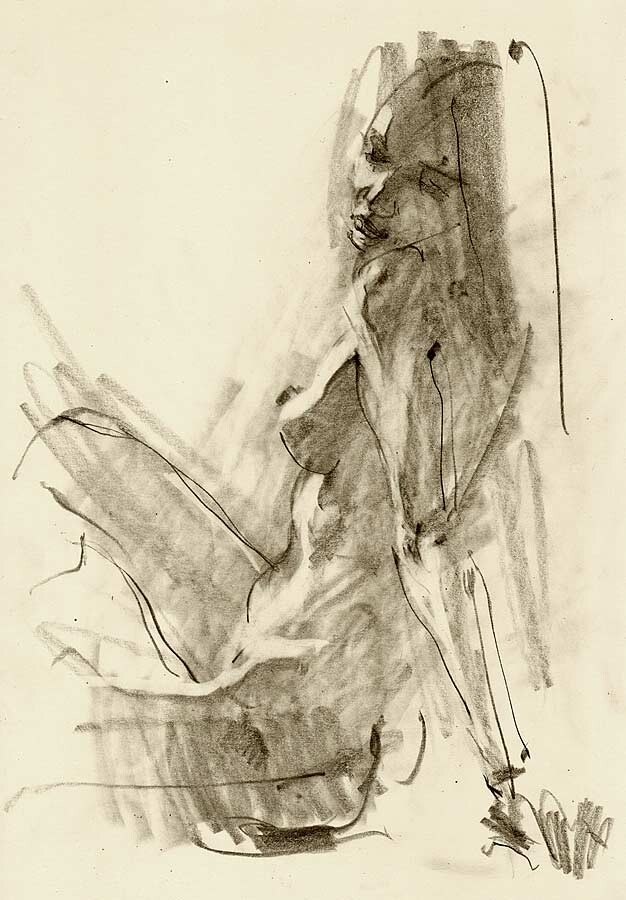
How the course works
The course is delivered as eight recorded video lessons, grouped into four modules. Each lesson is a demonstration you can draw alongside: the drawing is built in real time, with the decisions explained as they happen.
There is a practical assignment in every lesson. You can pause, rewind and repeat a section as many times as you need. Most students work through one lesson in a sitting, then spend another session repeating the exercise from their own reference.
You do not need to be online at a fixed time. The lessons are available in your account for four months from purchase, so you can fit the work around your week and return to the demonstrations when a particular angle gives you trouble.
The programme
The course is built in four modules. Each module pairs a feature study with a full-head application, so the new information is used before you move on.
1Module 1 — Profile and the eyeEstablish the profile and learn to place the eye as a form, not an outline.2 lessons · 74 min
- Drawing the head in profile: cranial mass, brow and jaw
- Drawing the eye in four angles: front, three-quarter, below and above
2Module 2 — Nose and lipsBreak the nose and mouth into planes and draw them from the same four viewpoints.2 lessons · 57 min
- Drawing the nose in four angles: bridge, tip and wings
- Drawing the lips in four angles: volume, corners and centre line
3Module 3 — Ear and front viewStudy the ear's structure, then bring all features together in a frontal head.2 lessons · 85 min
- Drawing the ear in four angles: helix, lobe and inner folds
- Drawing the full head in front view: alignment and likeness
4Module 4 — Turning and tilting the headApply the feature work to two demanding full-head poses drawn from video reference.2 lessons · 73 min
- Drawing the full head in three-quarter turn
- Drawing the full head in three-quarter view from below
What you get
A focused drawing course with the demonstrations and practice structure you need to improve.
- Eight recorded video lessons
About five hours of focused demonstration, split into four modules.
- Four-angle feature demonstrations
Eyes, nose, lips and ear shown from front, three-quarter, below and above.
- Full-head video studies
A frontal head study plus two turning and tilting head drawings.
- A practical assignment in every lesson
Draw alongside the lesson, then repeat the exercise from your own reference.
- Four months of platform access
Return to any lesson as often as you need during your access period.
- Self-paced viewing
Pause, rewind and work at your own speed on any device.
- 14-day refund policy
Review the first lessons and request a refund within 14 days if the course is not for you.

Is this course for you?
This course is for you if…
- You have never drawn a head and want a structured first path.
- You can draw but your features look flat or misaligned.
- You want to see the full drawing process, not just finished results.
- You are comfortable pausing and repeating exercises at your own pace.
- You want a focused course on heads rather than a broad painting programme.
Probably not a fit if…
- You are looking for live personal critique or one-to-one mentoring.
- You want a course on full-figure drawing or oil painting.
- You need a formal academic qualification.
- You are not willing to practise between lessons.
- You want a course about colour, landscape or still-life painting.
After the course
By the end, you will have a working sequence for any head you draw. You will start with the big mass, place the centre line, check the features against the turn of the face, and only then commit to detail.
You will know what to look for when an eye feels flat or a profile looks soft. You will be able to draw the nose, lips and ear from more than one angle, and you will have completed full-head studies from video reference that you can repeat with your own model or photograph.
The result is not a single finished portrait but a more reliable way of working. You can use it for quick sketches, longer drawings, or as preparation for painting, because the structural questions stay the same.
Questions before you start
How much time do I need each week?
The full course contains about five hours of video. Most students spread it over four to six weeks, drawing for 60 to 90 minutes once or twice a week. You can go faster or slower depending on your schedule.
Do I need previous drawing experience?
No. The course starts with the profile and builds feature by feature. Experienced artists can use it to tighten structure and proportion, while beginners get a clear sequence to follow.
What materials do I need?
A pencil, paper, an eraser and a way to view the lessons. The demonstrations are in graphite, and you can follow with pencil or charcoal. A kneaded eraser is useful but not essential.
How do I get access after payment?
After checkout you receive access to the course platform. The lessons are available in your account, and you do not need to install any special software.
How long do I keep access?
The course includes four months of access to all course materials from the date of purchase. During that period you can rewatch every lesson as often as you like.
What format are the lessons in?
The lessons are recorded video demonstrations with a practical assignment in each one. You draw alongside the video, pause when you need to, and replay sections as often as necessary.
Is there personal feedback or live teaching?
This self-paced edition is built around recorded lessons and practice assignments. It does not include live calls, personal critique or one-to-one mentoring.
What is the refund policy?
You can request a refund within 14 days of purchase. Contact support from the account you used to buy, and the refund will be processed according to the store policy.
Can I use my own reference photos?
Yes. The lessons use video reference, but the method applies to photographs and life drawing. Repeat each exercise with your own image once you have followed the demonstration.
Is this course about drawing or painting?
It is a drawing course in graphite. It focuses on structure, proportion and likeness. It does not cover oil painting, colour mixing or landscape painting.
Start with the profile
Eight lessons, four modules and a clear path from single features to a complete head.